Discover the magic of Christmas markets
Imagine a winter evening when the city glows with thousands of lights, the air fills with the scent of mulled wine and cinnamon, and every market stall echoes with the sound of conversations and laughter. Christmas markets are so much more than shopping – they’re a theatre of lights, sounds, and aromas that transports you straight into the world of childhood memories.
Each market has its own unique character – from grand stalls set in historic city centres to small, charming fairs hidden in narrow streets of smaller towns. It’s a place where tradition meets modernity, and local treats, handmade decorations, and music create an atmosphere you won’t experience anywhere else.
Exploring Christmas markets across Europe is also a journey through different cultures. Each country has its own customs and flavours – from German gingerbread and Austrian pastries to French pralines and Italian chocolate delights.
Why travel by coach?
Travelling to Christmas markets by coach lets you feel relaxed and festive right from the start – no worrying about parking, traffic, or navigating in a foreign city. You settle into a comfortable seat, recline the backrest, put on your headphones or chat with your loved ones while the driver takes you straight to the heart of the festive attractions. It’s also a budget-friendly option: often cheaper than flying or driving your own car, especially when you consider fuel, tolls, and parking fees.
A coach is also perfect for gift hunters – you can take a large suitcase and pack it with local delicacies, handmade crafts, and Christmas decorations without stress. Direct routes to many European cities mean you skip airport queues and gain more time to enjoy the beautifully lit streets. For many travellers, the journey itself becomes part of the adventure – a moment to rest, talk, or plan what to explore at the market.
Christmas market journeys across Europe
On the European map of Christmas markets, you’ll find both large, famous events in major capitals and cosy fairs hidden in historic neighbourhoods of smaller cities. Each country has its own traditions – from decorations and music to unique winter treats that taste best outdoors. It’s worth discovering these festive atmospheres not only in Poland but also across Europe – every region offers something entirely different, creating unforgettable experiences.
Below you’ll find a list of countries – click their names to open detailed descriptions of the Christmas markets in each country:
🇦🇹 AUSTRIA ✨
Austria is a classic choice for advent trips – the Christmas markets here are renowned for their historical locations, mountain scenery, and strong attachment to tradition. You’ll find the largest ones in Vienna, Salzburg, Innsbruck, and Graz, and many operate from around mid-November until Christmas, with some continuing even into the New Year.
Vienna
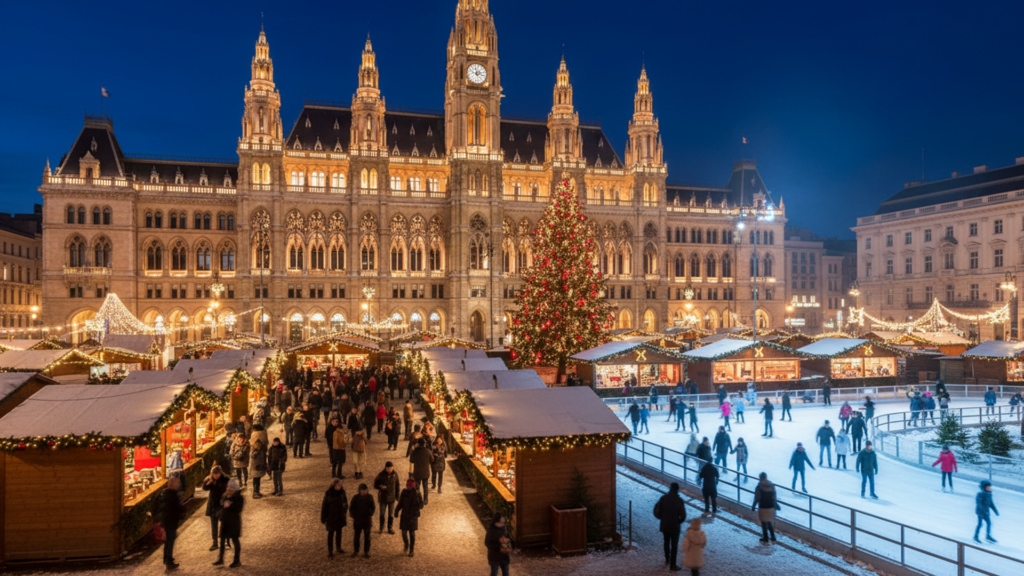
- Rathausplatz (Wiener Christkindlmarkt) – Vienna’s main Christmas market stretches out in front of the monumental City Hall, with dozens of stalls, a huge Christmas tree, and an illuminated ice rink in the park. This is the place for that classic “first impression” of Vienna: mulled wine, Christmas decorations, handicrafts, and long walks among the illuminations.
- Christmas Market at Schönbrunn Palace – takes place in the courtyard of the baroque palace, surrounded by over 90 elegant stalls with handicrafts, regional specialties, and a program for families. The atmosphere is more intimate and “courtly” – perfect if you enjoy the combination of history, architecture, and festive spirit.
- Christmas Village at Maria-Theresien-Platz – a market located between the Museum of Art History and the Museum of Natural History, with a row of stalls featuring handicrafts, snacks, and extensively developed illuminations. This is a good choice if you want to combine museum visits with a cup of punch right in the heart of “imperial” Vienna.
- Spittelberg – a street market in the narrow, cobblestone lanes of the former craftsmen’s quarter, known for its intimate atmosphere and high-quality handicrafts. It’s worth stopping by for more local food, such as potato pancakes or snacks to go with your punch, and to feel a more “neighborly” vibe than at the main square.
- Altwiener Christkindlmarkt at Freyung – a traditional “Old Viennese” market at the historic Freyung square, where Christmas markets were organized as early as the 18th century. This is a good place for classic nativity scenes, decorations, and souvenirs, as well as to try local punch surrounded by historic townhouses.
Salzburg, Innsbruck and Graz
- Salzburger Christkindlmarkt (Old Town) – a market in the very heart of the historic center, on the squares in front of the cathedral and the Archbishop’s Palace, considered one of the oldest and most beautiful in the world. In addition to stalls with decorations and food, you’ll find choir performances, traditional “tower blowing” from the walls, and a rich advent program.
- Salzburger Bergadvent in Grossarl (Mountain Advent) – an intimate, mountain market in Grossarltal, designed as a peaceful alternative to crowded cities. Attractions include a large nativity scene, “angel post office,” workshops for children, sleigh rides, and torch-lit walks, with the air filled with the scent of baked apples, chestnuts, and mulled wine.
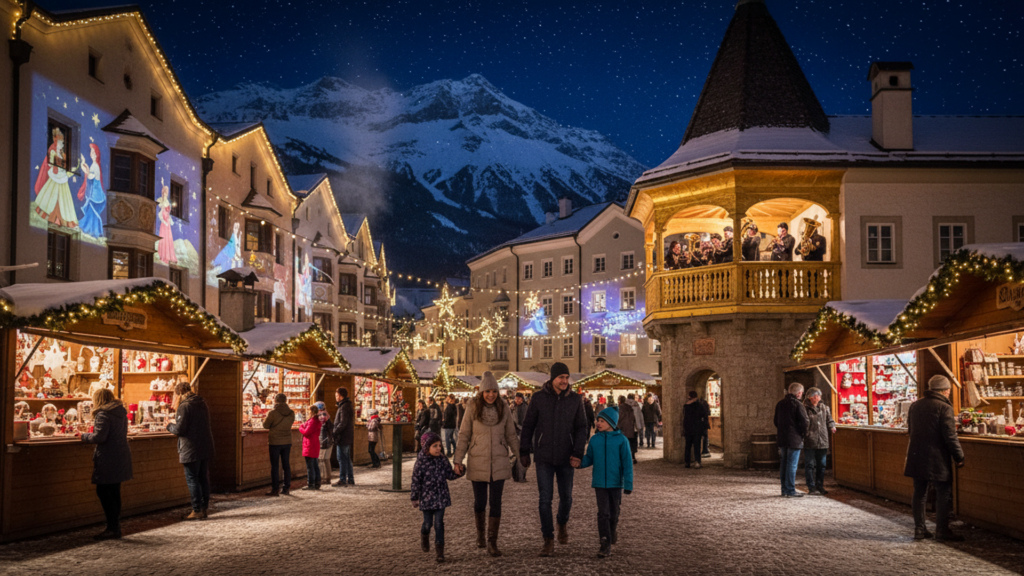
- Old Town Market in Innsbruck – set up directly beneath the Golden Roof, surrounded by medieval townhouses and Alpine peaks. Traditional stalls with decorations and woolen goods are characteristic here, as is brass music played from the terrace under the Golden Roof and a “fairy tale street” with characters from fairy tales on the facades.
- Hauptplatz Market in Graz – the main market on the representative square in front of the City Hall, with a huge Christmas tree and spectacular light projections on the facade. In addition to handicrafts and decorations, sweet snacks, waffles, and of course cups of glühwein are popular here, which make great souvenirs.
International coaches most often arrive at major transport hubs – near main railway stations or dedicated bus terminals – from where you usually have just a short tram, metro ride, or convenient walk to the historic centers of Vienna, Salzburg, Innsbruck, or Graz. Most of the listed markets are located literally in the heart of the city (town hall square, old town, main square), so after getting off public transport, you immediately immerse yourself in the festive crowds. Austrian markets typically operate from mid- to late November until Christmas, and some – like Salzburg or Schönbrunn – extend the season until the end of December or early January, giving you plenty of flexibility when planning your travel dates.
Tips for coach travelers
Sample connections from Poland 🇵🇱
❄️ Go back to the country list ⬆️
🇧🇪 BELGIUM ✨
Belgian Christmas markets combine medieval city centers, canals, and Art Nouveau townhouses with illuminated ice rinks, Ferris wheels, and long rows of wooden chalets. In Brussels, Bruges, Ghent, Antwerp, Liège, and Leuven, the Christmas offerings spread throughout the old towns, and each of these markets has a slightly different character – from big-city shows to intimate, student-friendly atmospheres.
Brussels
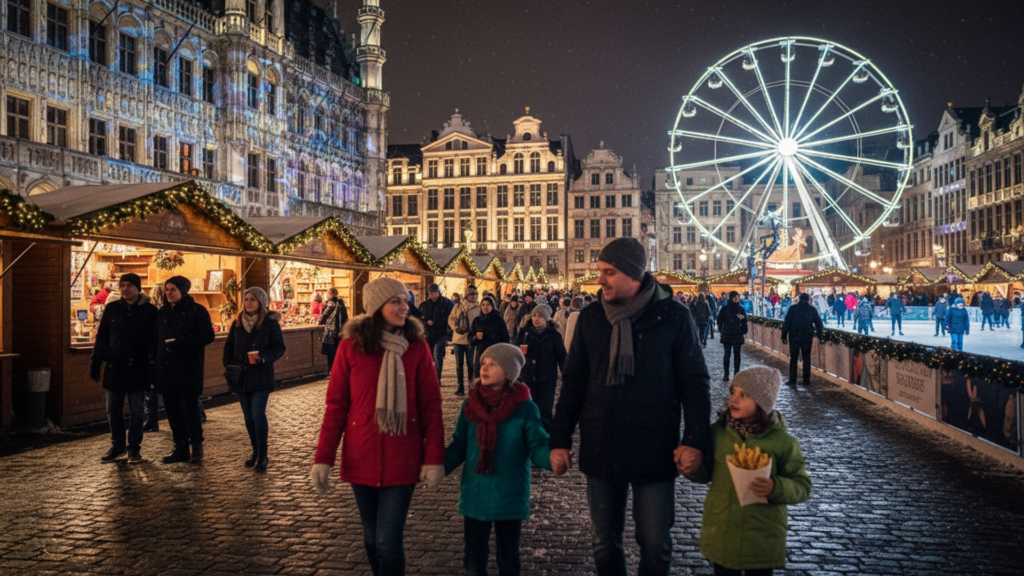
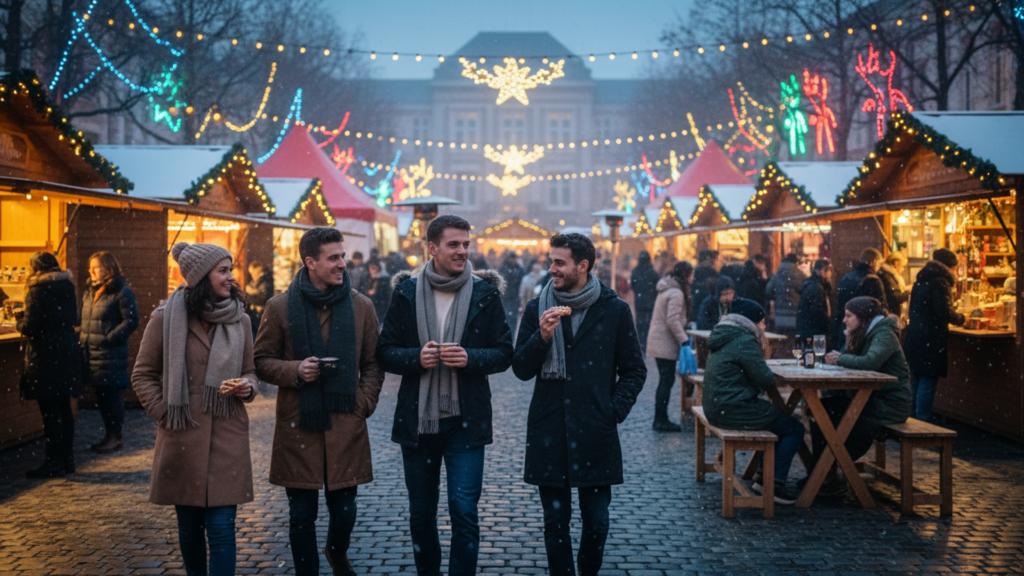
- Plaisirs d’Hiver – Winter Wonders is a huge event spanning several main squares in the city center: from Grand-Place, through the stock exchange area, to Place Sainte-Catherine and Marché aux Poissons. Visitors can enjoy dozens of stalls, a Ferris wheel, an ice rink, and a spectacular light and sound show on the Grand-Place facades; be sure to try Belgian waffles, fries, chocolate, and a mug of mulled wine or local beer.
Bruges
- Wintergloed – In Bruges, the markets fit into the fairytale scenery of canals, with the main markets set up on the Markt and Simon Stevinplein, complemented by an ice rink and winter bar around Minnewater. The city also organizes an evening “light trail” with light installations that adds atmosphere to walks; on site, it’s worth reaching for hot chocolate, speculoos cookies, and of course more versions of Belgian waffles.
Ghent
- Gentse Winterfeesten – In Ghent, the market takes the form of a winter festival stretching from Sint-Baafsplein by the cathedral, through Botermarkt, to Korenmarkt, with over 150 wooden chalets and a large Ferris wheel. There’s an ice rink at the city pavilion, amusement parks, and atmospheric bars with Belgian beer; plus stalls with cheeses, sausages, waffles, and other local snacks.
Antwerp
- Winter in Antwerpen – The winter festival in Antwerp covers several squares in the historic center, including Grote Markt, Groenplaats, Operaplein, and Hendrik Conscienceplein, combining a market with illuminations and cultural events. A distinctive feature is the large ice rink around the Rubens monument on Groenplaats, atmospheric winter bars, and light installations; among the delicacies, fries, sweets, and Christmas beers served in winter gardens reign supreme.
Liège
- Village de Noël de Liège – Liège creates a true “Christmas village” with about 200 chalets on Place Saint-Lambert, Place du Marché, and around the cathedral, considered one of the oldest and most famous markets in Belgium. Beyond shopping, the atmosphere counts here – the village has its own “mayor,” concerts, an ice rink, and a rich food offering: from regional products from the Ardennes, through Liège waffles, to Christmas beers, mulled wine, and the local pékèt liqueur.
Leuven
- Leuven Christmas Market – The market in Leuven has a more intimate, student-friendly character and is set up on two central squares – Ladeuzeplein and Herbert Hooverplein – with over a hundred stalls featuring handicrafts and local products. The atmosphere is relaxed and “neighborly”: in addition to decorations and gifts, you’ll find lots of regional sweets, street food, and a wide selection of Belgian beers served in heated areas.
Most of these markets take place in the historic city centers themselves – around main squares, town halls, and cathedrals – which means that after arriving in Brussels, Bruges, Ghent, Antwerp, Liège, or Leuven, you can easily reach them on foot or with a short public transport ride. The season in Belgium usually starts at the end of November: in Brussels, Bruges, Antwerp, or Liège, markets typically last until the turn of the year or early January, while Leuven organizes a shorter, two-week market in December – ideal for a quick pre-Christmas coach trip.
Tips for coach travelers
Sample connections from Poland 🇵🇱
❄️ Go back to the country list ⬆️
🇨🇿 CZECH REPUBLIC ✨
The Czech Republic is a classic winter destination from Poland – relatively close, with well-connected cities and a very strong tradition of Advent markets, especially in Prague and Moravia. During the Christmas season, historic squares in Prague, Brno, Olomouc, and České Budějovice transform into illuminated “villages” full of punch, svařák, trdelník, and live music.
Prague
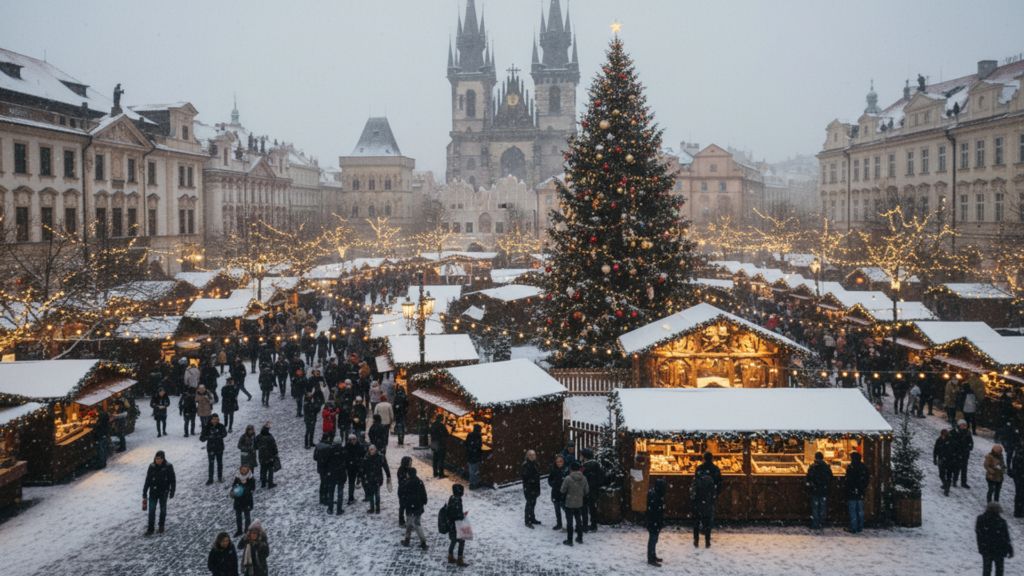
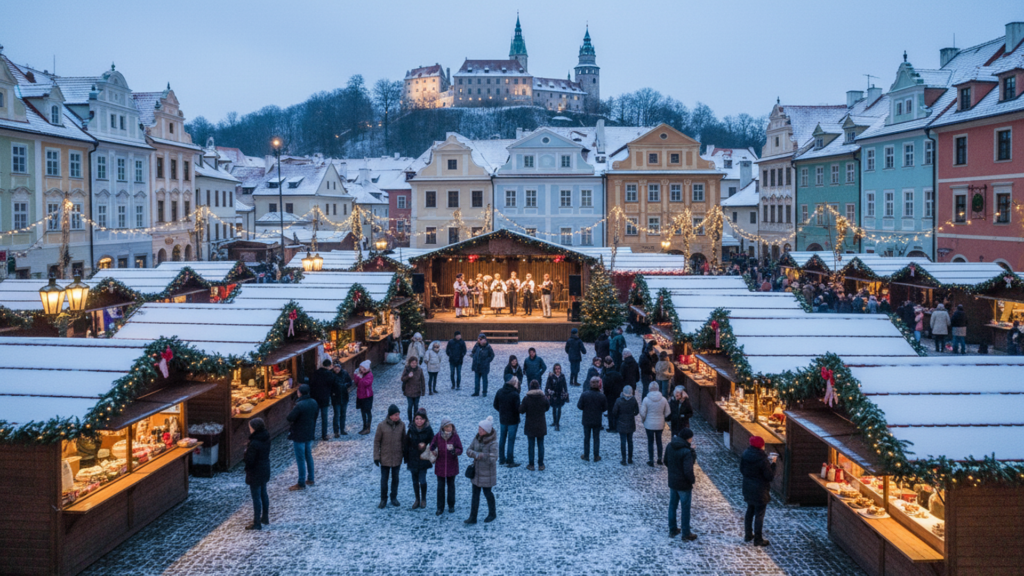
- Old Town Square (Staroměstské náměstí) – The main Christmas market in the Czech Republic, with a huge Christmas tree, stage, nativity scene, and dense array of wooden chalets in the heart of the old town. The most popular attractions are the daily tree lighting, concerts, the view of the square from the observation platform, and passing under the Astronomical Clock. The atmosphere is very “postcard-perfect” and crowded, typically touristy; be sure to try svařené víno (mulled wine), grilled sausages, trdelník, and roasted nuts.
- Wenceslas Square (Václavské náměstí) – The market on this long boulevard complements the Old Town Square – stalls stretch between department stores and the National Museum. This is a good place for quick snacks, hot drinks, and shopping for small souvenirs; the atmosphere is more “urban” and modern, with constant traffic and neon lights all around.
Brno
- Freedom Square (Náměstí Svobody) – The heart of Brno’s Christmas markets is Náměstí Svobody with the main stage, Christmas tree, and most spectacular festive setup, complemented by stalls at Zelný trh and Moravské náměstí. Popular attractions include concerts, illuminations, family zones at Dominikánské náměstí, and tasting local punches, mead drinks, and pork dishes.
Olomouc
- Upper Square (Horní náměstí) – Olomouc is famous for its very atmospheric, more local market at the Upper Square, set against the backdrop of the UNESCO-listed Holy Trinity Column. A unique feature is the extensive “punch” selection (dozens of types of punch and svařák), an ice rink, sometimes a Ferris wheel, and a stage with daily programs. Try local drinks, regional cheeses and sweets, and classic wooden and glass decorations.
České Budějovice
- Advent in České Budějovice – The Advent town occupies the monumental Přemysl Otakar II Square, with an ice rink around Samson’s Fountain, carousels, a Ferris wheel, and a craft street. The atmosphere is more intimate than Prague, but visually very impressive; typical offerings include local punches, trdelník, mead, and numerous craft stalls.
Pilsen
- Pilsen Christmas Market – The main market takes place at Republic Square, with St. Bartholomew’s Cathedral and a tall Christmas tree in the background. You’ll find a living nativity scene, a Ferris wheel, concerts, and a rich food selection – from sausages to sweet and savory pastries. It’s also worth exploring the city and learning about its historic attractions, including the birthplace of the famous Pilsner Urquell beer.
Karlovy Vary
- Karlovy Vary Christmas Market – Stalls are set up mainly at the Mill Colonnade and in Dvořák Gardens, with an artistic program at the colonnade and illuminations in the spa part of the city. The unique atmosphere is created by hot springs, elegant architecture, and winter-decorated colonnades; in addition to classic svařák and sweets, you’ll find local spa wafers and Becherovka liqueur.
Ostrava
- Ostrava Christmas Market – Ostrava’s market is mainly concentrated at Masaryk Square and surrounding city center streets, with a Ferris wheel, concert stages, an ice rink, and numerous themed zones. The atmosphere is more “festival-like” – lots of music, children’s attractions, craft demonstrations, and regional specialties from Moravian-Silesia, served in Christmas gardens.
Český Krumlov
- Náměstí Svornosti – In Český Krumlov, the Christmas market is set up on the small Náměstí Svornosti square, surrounded by colorful townhouses and the castle on the hill. This is a very intimate, “fairytale” market: a small stage, traditional performances, local products, and classic Czech delicacies – ideal if you’re looking for a quieter alternative to Prague.
International coaches to Prague, Brno, Olomouc, Ostrava, Pilsen, or Karlovy Vary usually stop at main bus or train stations, from where you can walk to the city center and Christmas markets or take 1–2 stops by tram or metro. Most of the described markets are located exactly on the main squares (Staroměstské náměstí, Václavské náměstí, Náměstí Svobody, Horní náměstí, Masarykovo náměstí, main city squares), so after a short walk from the stop, you immediately find yourself in the middle of the festive hustle and bustle. In the Czech Republic, the Christmas market season usually starts in the second half of November and lasts until Christmas, and in the largest cities – like Prague, České Budějovice, or Karlovy Vary – often until early January, making it easy to match your coach trip to a free weekend or Christmas holiday.
Tips for coach travelers
Sample connections from Poland 🇵🇱
❄️ Go back to the country list ⬆️
🇩🇰 DENMARK ✨
Danish Christmas markets combine Scandinavian minimalism with cozy hygge: atmospheric lighting, warm blankets, a cup of aromatic gløgg, and peaceful walks through historic streets are what matter here. The most famous markets take place in Copenhagen, Aarhus, and Odense, where Christmas decorations harmoniously blend into the city’s everyday life.
Copenhagen
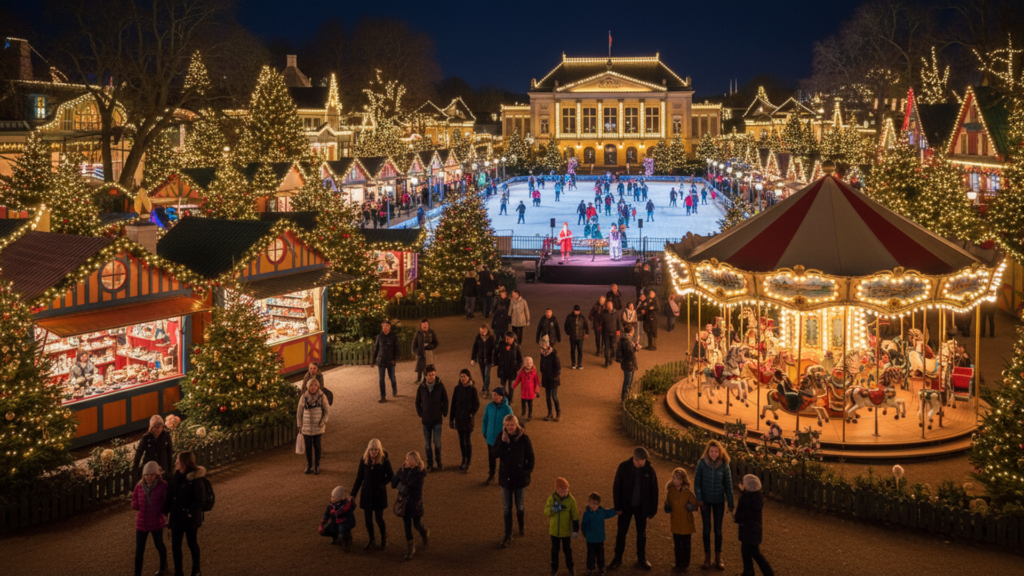
- Jul i Tivoli (Christmas at Tivoli Gardens) – Tivoli is one of the world’s most famous Christmas parks – this historic amusement park transforms into a fairytale village with thousands of lights, over a thousand Christmas trees, and about 60 stalls. Besides classic market stalls, there are carousels, an ice rink in front of the concert hall, performances and shows that create a complete “park” experience; be sure to try gløgg, æbleskiver (Danish doughnut balls), and Christmas sweets.
- Højbro Plads Market – This market lies in the heart of the city, between the Strøget pedestrian street and Christiansborg, and is known for thousands of lights, festively decorated Christmas trees, and a row of wooden chalets. The atmosphere is intimate and very “hygge”: alongside classic decorations and handicrafts, you’ll find Danish delicacies like æbleskiver, brændte mandler (roasted almonds), and cups of gløgg.
- Nyhavn Christmas Market – Nyhavn focuses more on scenery than scale – colorful townhouses and a canal with moored boats create the backdrop for a row of Christmas stalls along the waterfront. It’s an ideal spot for an evening stroll with lights reflecting on the water; in the wooden chalets, you can buy decorations, hot drinks, fish snacks, and typical Danish pastries.
- H.C. Andersen Christmas Market – The H.C. Andersen Christmas Market in Copenhagen takes place on Gammeltorv square in the historic center and references the Danish writer’s fairy tales. Each chalet has a name related to his stories, characters from Andersen’s tales and Julemanden (the Danish Santa Claus) appear, and the offerings include traditional sweets, handicrafts, and a program for families with children.
Aarhus
- Jul i Den Gamle By (Christmas in the Old Town) – In Aarhus, the best way to experience the Christmas atmosphere is at Den Gamle By – an open-air museum town where Danish Christmases from the past 400 years are recreated. You walk cobblestone streets between historic houses, peek into shops decorated “like in the old days,” taste traditional dishes and sweets, and children can visit Santa’s attic or themed alleyways.
Odense
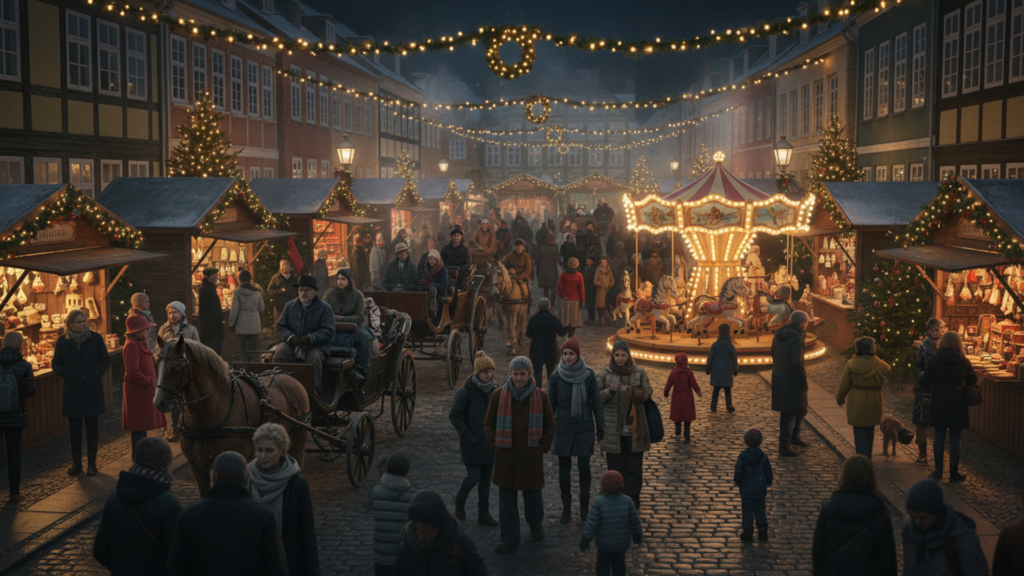
- H.C. Andersen Julemarkedet (H.C. Andersen Christmas Market) – In Odense, Andersen’s hometown, the market takes place in the cobblestoned old part of the city (including Sortebrødre Torv), styled after the writer’s era. Besides stalls with handicrafts and food, there are street performers, enacted scenes, carriage rides, and attractions for children; among the flavors, look for traditional Danish pastries, hot chocolate, and local versions of gløgg.
International coaches to Copenhagen, Aarhus, or Odense usually stop near major train or bus stations, from where you can reach the city center and markets on foot or in a few minutes by public transport. Most of the described markets are located right in the historic parts of the cities (near Strøget, Nyhavn, Gammeltorv, in Den Gamle By, or in Odense’s old town), and the Christmas season usually begins there in mid- to late November; the Tivoli market lasts until early January, which gives great flexibility when planning a coach trip.
Tips for coach travelers
Sample connections from Poland 🇵🇱
❄️ Go back to the country list ⬆️
🇪🇪 ESTONIA ✨
Estonia focuses on Christmas in the atmosphere of a peaceful, northern “fairy tale”: small, compact old towns, lots of lights, ice underfoot, and a cup of hot glögi in hand. The most important markets can be found in Tallinn, Tartu, and Pärnu, where historic squares transform into winter towns with ice rinks, concerts, and local handicrafts.
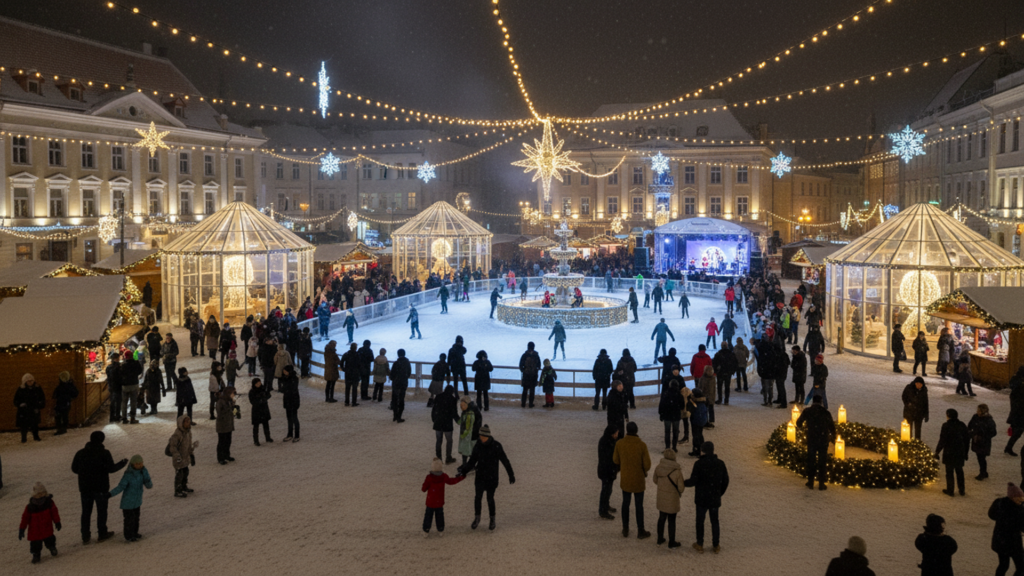
Tallinn
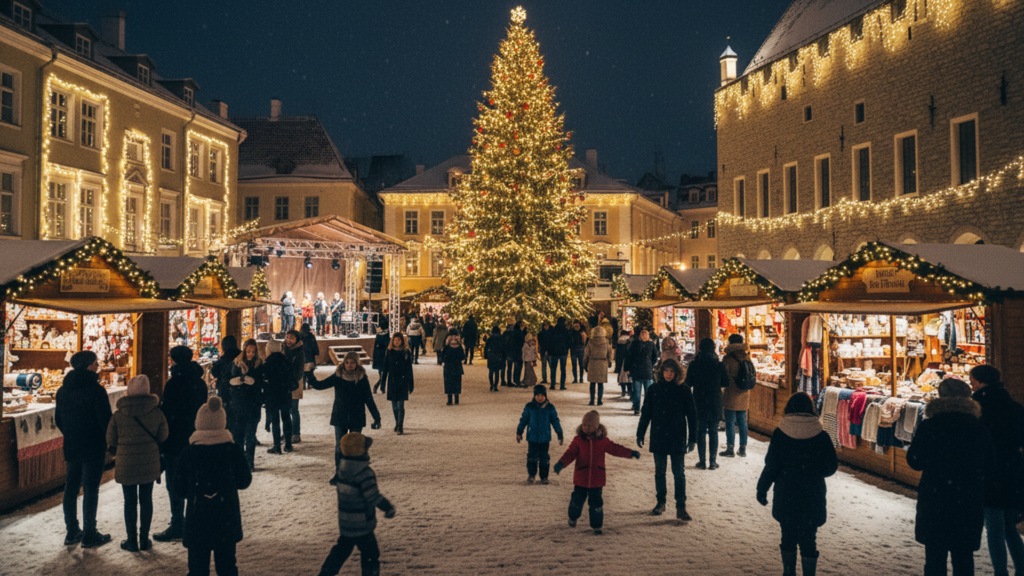
- Tallinn Christmas Market (Tallinna Jõuluturg) – The main market takes place at Town Hall Square (Raekoja plats) in the heart of the medieval Old Town and is considered one of the most “fairytale-like” in the region. Characteristic is the tall Christmas tree standing in the middle of the square, surrounded by wooden chalets with handicrafts, woolen goods, local delicacies, and a stage with a music program; be sure to try glögi, gingerbread, sausages, and warm potato-based dishes.
- Alternative Markets (Telliskivi, EKA, Museum Markets) – Beyond the main square, the city organizes smaller, more “local” markets, including in the creative Telliskivi district, at the Estonian Academy of Arts (EKA), and at museums. These are usually shorter events focused on design, contemporary crafts, student and local artist works, with food trucks, specialty coffee, and a less touristy atmosphere.
Tartu
- Town Hall Square Market – In Tartu, the city’s Christmas heart beats at Raekoja plats, which during Advent transforms into “Tartu Christmas City” with glass pavilions, an ice rink around the “Kissing Students” fountain, and Christmas installations. The program includes concerts, workshops, meetings with Santa, and evening Advent candle lighting, and in the wooden chalets you can buy Estonian handicrafts, cheeses, sausages, and warming drinks.
- Estonian National Museum Market – The Estonian National Museum (ERM) organizes its own shorter markets and Christmas events, often combined with folk tradition demonstrations and workshops. This is a good place to see what old Estonian Christmases looked like and buy more traditional handicrafts.
Coaches to Tallinn and Tartu usually stop near the main bus stations, from where you can walk to the old towns and town hall squares or take a few stops by tram or bus. The main markets – including Tallinna Jõuluturg and Tartu Christmas City – usually operate from the end of November until Christmas, and in Tallinn and Tartu, the Christmas towns function until the end of December or early January, making it easier to plan a coach trip between Christmas and New Year’s as well.
Tips for coach travelers
Sample connections from Poland 🇵🇱
❄️ Go back to the country list ⬆️
🇫🇷 FRANCE ✨
France is a mix of grand, spectacular markets and intimate “villages of light” – from Parisian parks and boulevards to Alsatian old towns and seaside promenades. The most famous markets can be found in Paris, Strasbourg, Colmar, Lyon, Lille, Reims, and Bordeaux, where Christmas illuminations blend beautifully with local cuisine and wine.
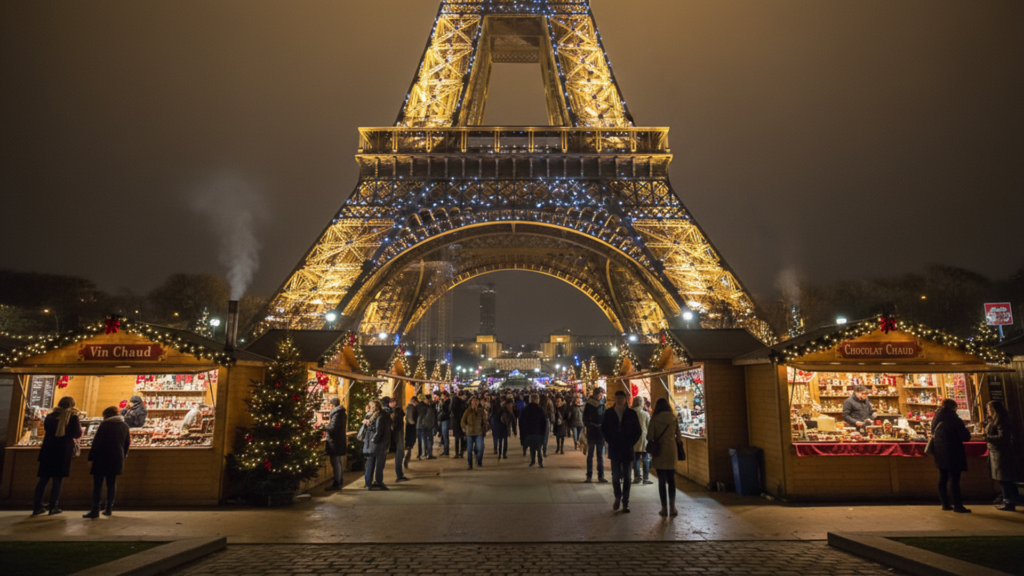
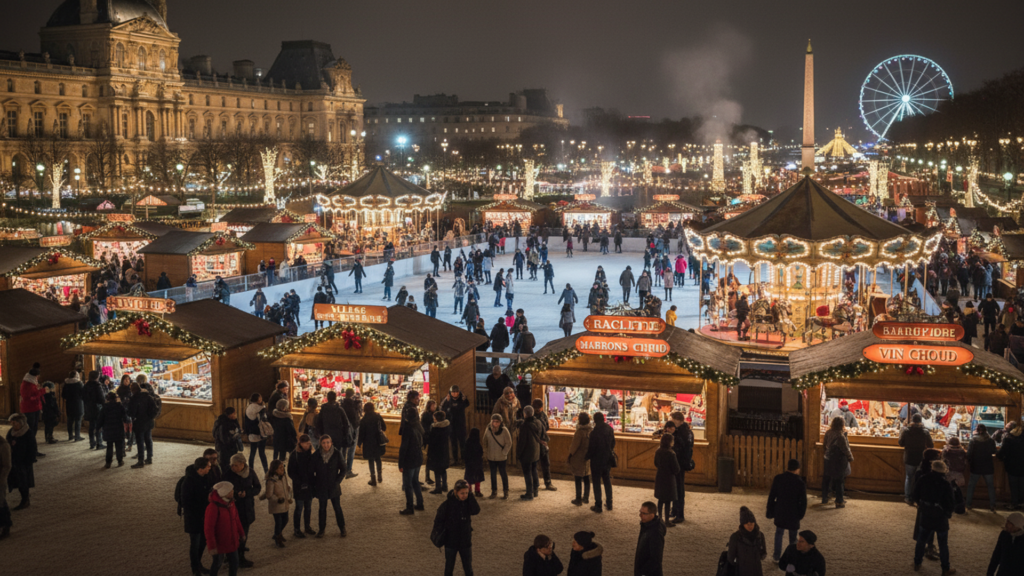
Paris
- La Magie de Noël in Tuileries Gardens – The largest Christmas market in Paris occupies the Jardin des Tuileries between the Louvre and Place de la Concorde and combines a classic marché de Noël with an amusement park – dozens of wooden chalets, an ice rink, carousels, and a “craftsmen’s village” zone. Among the aromas, raclette, waffles, churros, roasted chestnuts, and vin chaud reign supreme – this is a good place if you want an intense, very “entertaining” Christmas atmosphere.
- La Défense Market (Le Village de Noël) – At the La Défense parvis, the largest market in Île-de-France is created with several hundred Alpine chalets, an ice rink, a huge Christmas tree, a DJ zone, and after-work entertainment. The atmosphere is more “after-work”: lots of food trucks, places with raclette, Christmas sandwiches, and mulled wine, and prices tend to be somewhat gentler than in central Paris.
- Saint-Germain-des-Prés Market – An intimate, elegant market along Boulevard Saint-Germain, next to the Saint-Germain-des-Prés church, known for refined stalls with handicrafts, jewelry, and regional products. The wooden chalets and decorations fit into the atmosphere of the Left Bank of the Seine – this is a good place for quieter gift shopping over a cup of vin chaud.
- Christmas Village at the Eiffel Tower – At the foot of the tower on Quai Jacques Chirac and on the first floor, small Christmas villages emerge with chalets full of crafts, French specialties, and hot drink stands. The biggest asset is the view – you can sip mulled wine or hot chocolate with the illuminated tower literally above your head.
Strasbourg
- Christkindelsmärik – Strasbourg calls itself the “Capital of Christmas,” and its Christkindelsmärik spreads across many squares in the historic center, including Place Broglie, around the cathedral, and Place Kléber with the huge Christmas tree. This is classic Alsatian Christmas: wooden chalets, bredele (Christmas cookies), gingerbread, local wines and punches, all set against the backdrop of the Gothic cathedral and narrow streets.
Colmar
- La Magie de Noël – In Colmar, six markets scattered throughout the fairytale Old Town and Petite Venise district create one cohesive “theater of Christmas.” In the narrow streets and over the canals, the scent of bredele, gingerbread, and mulled wine from Alsace fills the air, and in the wooden chalets, high-quality local products and handicrafts dominate.
Lyon
- Place Carnot Market – Lyon’s main market creates a “Christmas village” in the heart of the Presqu’île, on Place Carnot, with about a hundred chalets offering local crafts and regional specialties. Among the delicacies you’ll find pain d’épices, cheeses, sausages, and vin chaud, all complemented by family entertainment and illuminations between the Rhône and Saône.
- Le Marché de Noël africain – The African Christmas Market is a themed event inspired by African cultures: colorful fabrics, handicrafts, jewelry, and stalls with dishes and spices that bring completely different flavors and rhythms to French Christmas. This is a proposal for those seeking a less obvious, multicultural face of Christmas.
Montbéliard
- “Lumières de Noël” – Montbéliard is famous for its impressive illuminations – over 100,000 lights, arches, and garlands transform the historic center “Cité des Princes” into a grand stage of light. At the foot of Saint-Martin church, an authentic market operates with craftsmen carefully selected by the organizers, and alongside classic vin chaud, local Franche-Comté specialties appear.
Lille
- Lille Christmas Market – In Lille, the Christmas market occupies primarily Place Rihour, with about 90 chalets, while nearby on Grand’Place stand a huge Christmas tree and a Ferris wheel. Among the stalls you’ll find a mix of French and Flemish specialties, traditional decorations, handicrafts, and plenty of places with mulled wine and beer.
Reims
- Reims Christmas Market – The market in Reims is set up on Hautes Promenades near the famous Notre-Dame cathedral, with about 150 chalets offering local products and Christmas handicrafts. In the evening, it’s worth combining a visit to the market with the Regalia light and sound show on the cathedral’s facade and a tasting of champagne or regional delicacies.
Bordeaux
- Bordeaux Christmas Market – Bordeaux organizes its marché de Noël on the huge Place des Quinconces in the city center, where over 100 exhibitors present crafts, decorations, and local delicacies. This is a good place to combine a “wine” visit with buying Christmas gifts – from candles and decorations to food products ideal for the Christmas table.
International coaches to Paris, Strasbourg, Lyon, Lille, Reims, or Bordeaux usually stop near major train stations or special bus terminals, from where you can reach the city center and markets by metro, tram, or on foot in about ten minutes. Most of the described markets are located directly in the heart of the city – at large squares (Place Carnot, Place des Quinconces, Hautes Promenades), old towns, or icons like the Eiffel Tower – so after a short transfer from the station, you immediately immerse yourself in the festive atmosphere. The season in France usually starts at the end of November and lasts until Christmas, with the largest markets in Paris, Colmar, or Reims operating until the end of December, and some Parisian ones (Tuileries, Saint-Germain, around the Eiffel Tower) also in early January – giving great flexibility when planning a coach trip.
Tips for coach travelers
Sample connections from Poland 🇵🇱
❄️ Go back to the country list ⬆️
🇪🇸 SPAIN ✨
Spain takes a “relaxed” approach to Christmas: lots of lights, street life, and outdoor concerts, often at much milder temperatures than in Central Europe. The most important markets can be found in Madrid, Barcelona, Malaga, Seville, and Bilbao, and the Costa Blanca coast (including Alicante and surroundings) complements it all with smaller, local markets featuring crafts and live music.
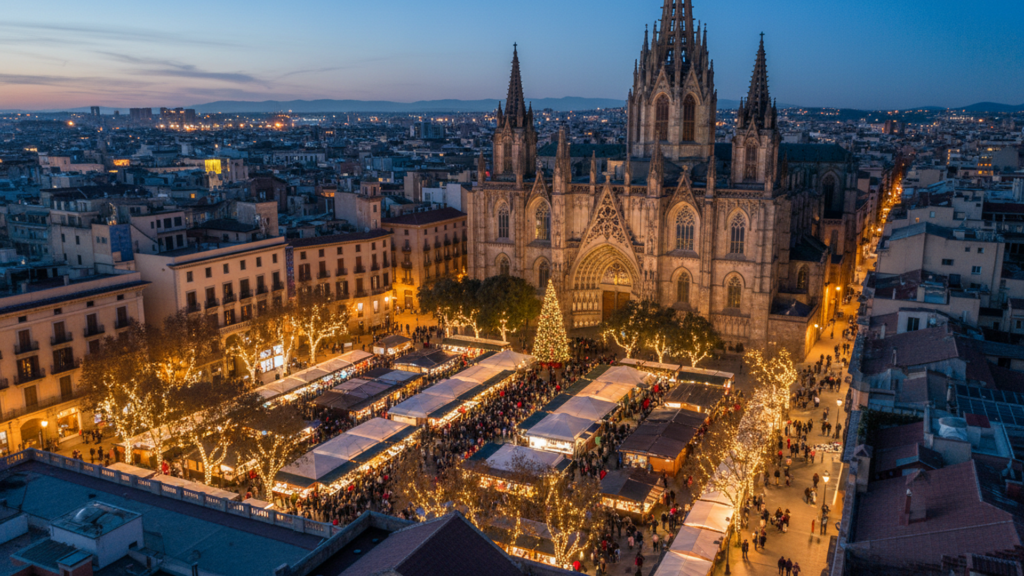
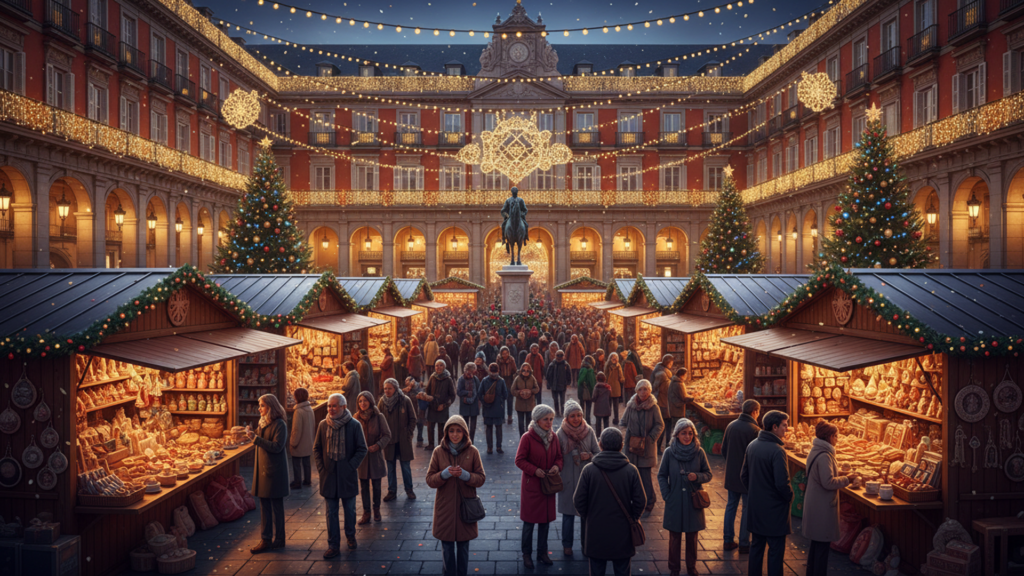
Madrid
- Plaza Mayor Market – The classic market at Plaza Mayor is the heart of Christmas Madrid: the historic square fills with over a hundred stalls selling nativity scene figurines (belén), decorations, toys, and sweets like turrón and polvorones. Around Plaza de Cibeles and Paseo de Recoletos, additional markets and craft fairs appear, easily combined with a walk along the Christmas illuminations route through the center. Madrid also occasionally hosts “German-style” markets – smaller fairs with sausages, pretzels, beer, and mulled wine that stylistically resemble classic German markets and provide an interesting contrast to Spanish traditions.
Barcelona
- Fira de Santa Llúcia, Sagrada Família, Moll de la Fusta, Santa Maria del Pi – Fira de Santa Llúcia is Barcelona’s oldest market, organized in front of the cathedral in the Gothic Quarter, with over two hundred stalls selling nativity figurines, branches, decorations, and typically Catalan touches (caganer, caga tió “log”). The second important market operates at Sagrada Família – more local in atmosphere, with about a hundred stalls around the basilica, where you can buy handicrafts, Christmas trees, snacks, and gifts in a slightly quieter atmosphere than in the city center. The Christmas market at Moll de la Fusta by the port and the artistic market at Santa Maria del Pi church focus more on design, handicrafts, jewelry, and street food – good options when you want to escape the biggest crowds at the cathedral.
Malaga
- Calle Larios Lights and Paseo del Parque Market – Malaga’s biggest attraction is the light and music show on Calle Larios – a spectacular illumination “tunnel” with a three-times-nightly show synchronized with music that draws thousands of people daily. A few minutes away, in Paseo del Parque, a traditional market stretches out with wooden stalls, handicrafts, local sweets, and snacks, ideal for a quieter walk after the light show.
Seville
- Feria del Belén and Mercado/Feria de Artesanía – Feria del Belén appears by the cathedral, along Avenida de la Constitución and around Plaza del Triunfo – it’s one of Spain’s most important markets for nativity figurines and accessories. The second pillar of Christmas trade is the Feria/Mercado de Artesanía Creativa at Plaza Nueva, where dozens of craftspeople sell ceramics, jewelry, leather goods, and other Andalusian handicrafts – a great place for more unique gifts.
Bilbao
- Mercado de Navidad at Muelle de Ripa – Bilbao organizes its main market along Muelle de Ripa by the Nervión River, often next to the Gabonart craft fairs. In the wooden chalets you’ll find decorations, Basque regional products, snacks and drinks, and nearby an ice rink and additional attractions appear, creating a compact but very atmospheric “winter village.”
Alicante
- El Valle, Crafts, Pinoso – Alicante itself transforms into a Christmas town with the main market at Plaza del Ayuntamiento, additional candy and craft markets, and a series of events from parades to concerts. Around the city, in the Costa Blanca region, numerous smaller markets operate – such as El Valle Christmas Market, Christmas craft fairs, or the Pinoso market – focused on local handicrafts, food products, children’s workshops, and the neighborly atmosphere typical of Spanish towns.
International coaches to Madrid, Barcelona, Malaga, Seville, Bilbao, or Alicante usually stop at main bus or train stations, from where you can reach the city center and Christmas markets by metro, bus, or on foot in ten to several dozen minutes. Most of the described markets operate exactly where city life takes place – on main squares (Plaza Mayor, around the cathedral in Barcelona, Paseo del Parque in Malaga, Plaza Nueva in Seville, Muelle de Ripa waterfront in Bilbao, or squares in central Alicante), so after a short transfer from the station, you land right in the middle of the festive bustle. The market season in Spain usually starts at the end of November or early December and lasts until Christmas, and in large cities often until the Feast of the Three Kings on January 6 – making it easier to plan a coach trip even after Christmas.
Tips for coach travelers
Sample connections from Poland 🇵🇱
❄️ Go back to the country list ⬆️
🇳🇱 NETHERLANDS ✨
The Netherlands is associated with canals and bicycles, but in December it also transforms into a country of atmospheric markets – from the illuminated squares of Maastricht to the underground “cities of light” in Valkenburg. Winter events often combine classic stalls with ice rinks, light shows, and a strong emphasis on local crafts and design.
Maastricht
- Magisch Maastricht Vrijthof – The main Vrijthof square transforms into a winter wonderland with a covered ice rink, Ferris wheel, carousels, and rows of wooden chalets. Attractions include “Santa’s House,” gastronomic zones, and a view of the city from the 45-meter wheel, with a menu featuring oliebollen, poffertjes, local Limburg specialties, and mulled wine.
Amsterdam
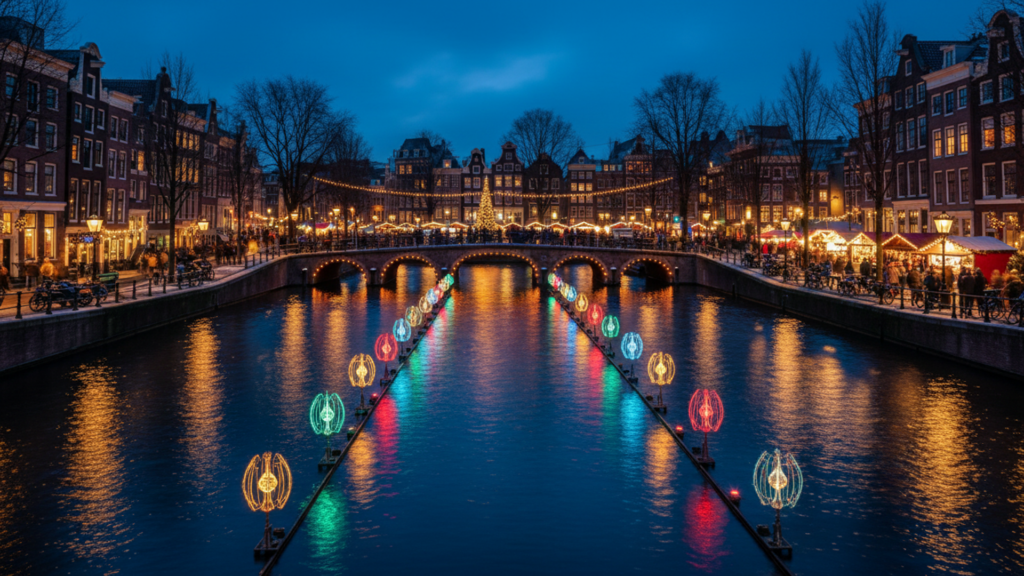
- Het Amsterdamse Winterparadijs & Ice*Village, Funky Xmas Market, Amsterdam Light Festival – Het Amsterdamse Winterparadijs is a huge, more “festival-like” winter park at the RAI convention center, with indoor and outdoor ice rinks, a Ferris wheel, après-ski zone, tube slides, and a rich food offering. A more classic version can be found at Museumplein: Ice*Village is a market with an ice rink and about 40–50 stalls, right next to the Rijksmuseum and Van Gogh museums – ideal for combining skating, shopping, and culture. Once a year, Funky Xmas Market also takes place at Westergas – a one-day design, fashion, and art market with local creators, street food, live music, and mulled wine. Meanwhile, Amsterdam Light Festival transforms the canals into a gallery of light installations viewed from boats or during a walk – a great complement to visiting the markets.
The Hague
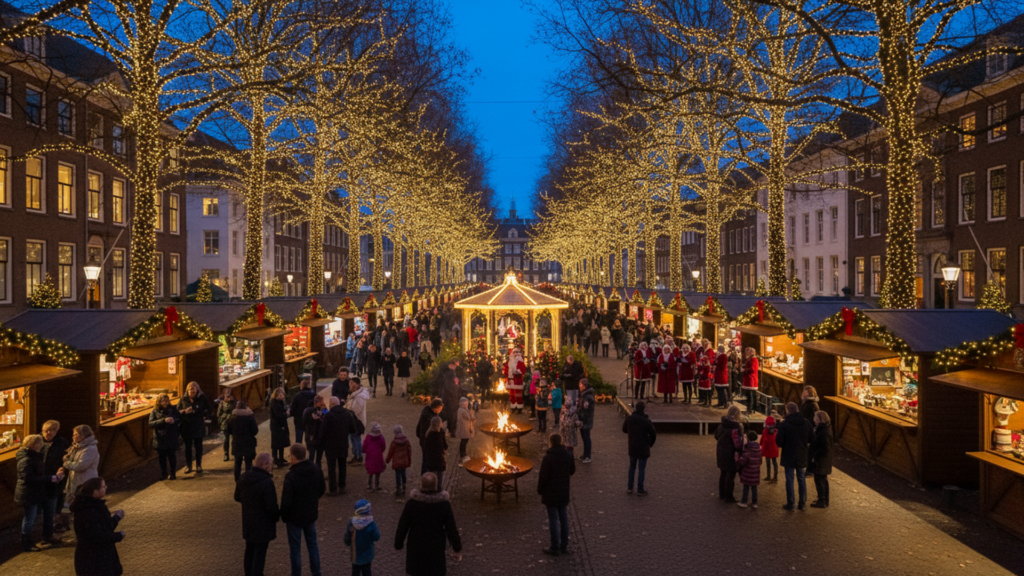
- Royal Christmas Fair – stretches along the elegant Lange Voorhout avenue in The Hague’s historic center and is considered one of the most beautiful markets in the country. Dozens of Christmas chalets, about 100,000 lights in tree canopies, bonfires, mulled wine, daily Santa visits, choirs, storytellers, and children’s entertainment create a very “royal” yet intimate atmosphere.
Dordrecht
- Dordrecht Christmas Market – Dordrecht organizes one of the largest markets in the Netherlands – several hundred stalls stretch across several kilometers of the historic center and along the waterfront, creating an extensive walking route. Besides classic chalets with handicrafts and food, there are concerts, smaller stages, food trucks, an ice rink, and additional “winter” attractions, all set against historic townhouses and the Grote Kerk church.
International coaches to Amsterdam, Maastricht, The Hague, or the Rotterdam area usually stop at major bus stations or main railway stations, from where you can reach the city center and markets by train, tram, or bus in about ten minutes. Vrijthof in Maastricht, the caves in Valkenburg (with easy train access from Maastricht), Museumplein and RAI in Amsterdam, Lange Voorhout in The Hague, or the historic center of Dordrecht are all close to public transport stops, so after a short transfer from the station, you’ll immediately find yourself in the heart of the festive bustle. Dutch markets usually start in the second half of November or early December and run until mid- or late month, with some events – like Magisch Maastricht, the Valkenburg cave markets, Ice*Village, Amsterdam Winterparadijs, or Royal Christmas Fair – operating until the period between Christmas and New Year’s, making it easier to fit a coach trip into your free days.
Tips for coach travelers
Przykładowe połączenia z Polski 🇵🇱
❄️ Przejdź z powrotem do listy krajów ⬆️
🇩🇪 GERMANY ✨
Germany is the true homeland of Christmas markets. From bustling stalls in large cities to intimate markets in charming towns – everyone will find something here. Aromatic scents of mulled wine, handmade decorations, and traditional treats create an unforgettable Christmas atmosphere that delights both adults and children.
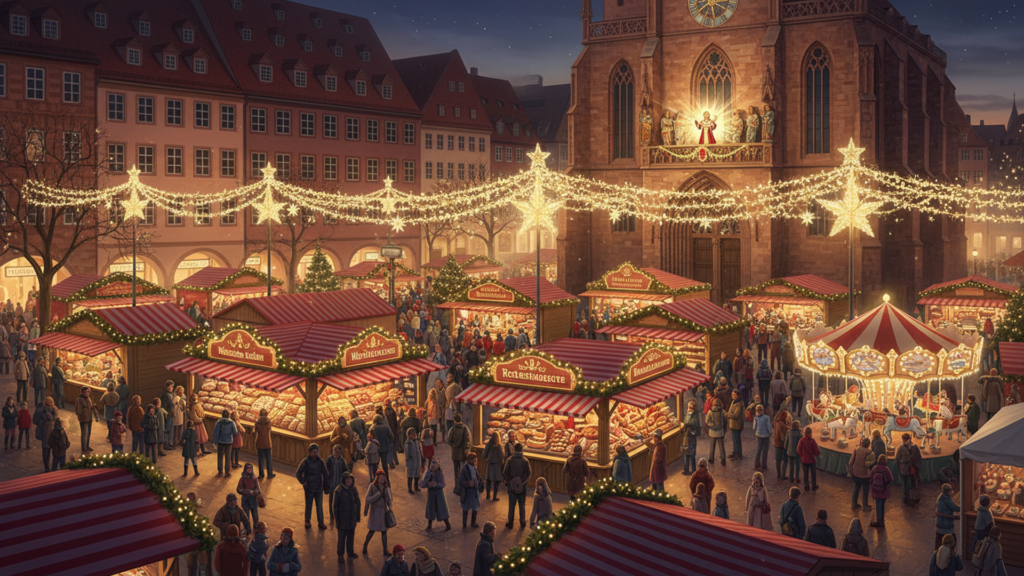
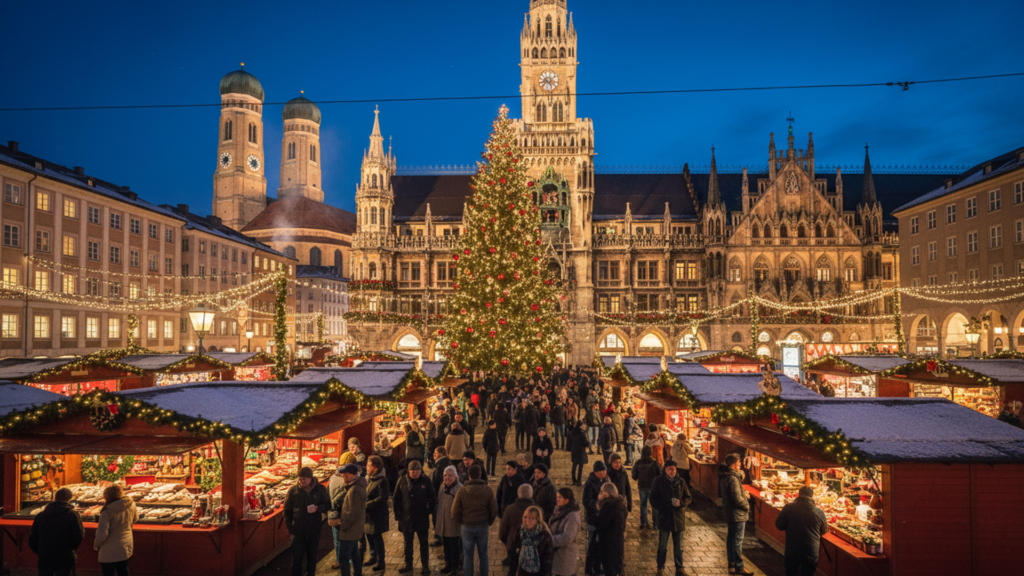
Nuremberg
- Christkindlesmarkt – The Christkindlesmarkt at Hauptmarkt is famous for its red-and-white stalls, the “Männleinlaufen” figures, and the presence of the Christ Child, who solemnly opens the market from the church balcony. Be sure to try Nuremberg gingerbread, small Nürnberger Rostbratwurst sausages, and classic glühwein, and also visit the neighboring Kinderweihnacht – a children’s market with carousels and workshops. This is one of the most “textbook” Christmas markets in Germany.
Dresden
- Dresden Striezelmarkt – The Striezelmarkt at Altmarkt is one of the oldest Christmas markets, and its symbol is the tall wooden pyramid and traditional Dresden Stollen. During the season, the city also organizes the Stollen Festival, and in the surrounding streets you’ll find more smaller markets – from medieval to artistic. The whole scene is especially impressive after dark, when the old town is fully illuminated.
Cologne
- Neumarkt, Cathedral, Heinzels Wintermärchen, Rudolfplatz – By the cathedral in Cologne, there’s a huge market with red structures, a music stage, and a tall Christmas tree against the backdrop of the monumental church. At Neumarkt, the “Angels Market” enchants with bright illuminations and white decorations, while Heinzel’s Wintermärchen at Heumarkt and Alter Markt creates a fairytale setting with an ice rink and carousels. Santa’s Village at Rudolfplatz, by the medieval walls, is especially popular with families – featuring Santa characters, workshops, and sweets for children.
Munich
- Marienplatz Market – The market at Marienplatz surrounds the neo-Gothic town hall and tall Christmas tree, with the towers of Frauenkirche church visible in the background. Among the stalls, there’s no shortage of Bavarian specialties – white sausages, roasted chestnuts, pretzels, and of course glühwein – and the surrounding streets hide smaller markets, such as a medieval craft fair. In the evening, when the town hall facade is illuminated, the square takes on a very cinematic character.
Stuttgart
- Stuttgarter Weihnachtsmarkt – The Stuttgarter Weihnachtsmarkt extends across several squares, including Schlossplatz and Marktplatz, and its trademark is the extremely richly decorated roofs of the stalls – each chalet competes here for the title of most beautiful. Besides classic dishes and crafts, you’ll find a children’s area with carousels and a mini-train, as well as special musical events. The menu includes Swabian Maultaschen dumplings, soups, raclette, and sweets.
Dortmund
- Dortmunder Weihnachtsstadt – The central point is a gigantic Christmas tree built from hundreds of real spruces at Hansaplatz, decorated with thousands of lights. Around it and in neighboring squares stretches a classic market with hundreds of stalls, stages, carousels, and food zones. The entire city center functions during this time as “Weihnachtsstadt,” which is visible in the illuminations and decorations.
Berlin
- WeihnachtsZauber at Bebelplatz – WeihnachtsZauber moved from Gendarmenmarkt to Bebelplatz but retained the character of an elegant, atmospheric market surrounded by the representative buildings of the opera, cathedral, and university. Among the stalls, carefully selected crafts, jewelry, high-quality decorations, and regional products dominate, often with the addition of live classical and jazz music. This is a good choice for a quieter evening over a glass of mulled wine, when the atmosphere of the place is more important than an “amusement park.”
- Christmas Market at Charlottenburg Palace – In front of the Baroque Charlottenburg Palace, a romantic market is created with rows of white tents and wooden chalets against the backdrop of the illuminated facade. The offering includes handicrafts, traditional Christmas products, home decorations, and classic German and Austrian cuisine dishes served in a more “restaurant” than fairground atmosphere. In the evening, the whole scene takes on a special character – it’s a great place for a peaceful walk combined with a visit to the palace gardens.
- Berlin Christmas at the Red Town Hall (Rotes Rathaus) – “Berliner Weihnachtszeit” at the Red Town Hall is famous for its Ferris wheel with a view of the TV tower, ice rink around Neptune Fountain, and a village of chalets styled after old Berlin. The market combines typically German food (sausages, kartoffelpuffer, roasted almonds) with children’s attractions in the style of a traditional fairground. This is one of the best places to “check off” a typical Berlin Christmas vibe surrounded by the city’s iconic symbols.
Upon arrival, coaches usually stop near major transport hubs; from there you can easily reach the centers with markets (Hauptmarkt in Nuremberg, Altmarkt in Dresden, Marienplatz in Munich, markets in central Berlin) by S-Bahn, tram, or on foot. The season for German markets usually runs from the end of November to December 23–24, but some, especially in large cities, also operate between Christmas and New Year’s, which is worth considering when choosing your travel dates.
Tips for coach travelers
Sample connections from Poland 🇵🇱
❄️ Go back to the country list ⬆️
🇨🇭 SWITZERLAND ✨
Switzerland enchants with Alpine landscapes that gain a Christmas setting in December. Instead of one central market, in many Swiss cities you’ll find several charming markets scattered among railway stations, along lakeside promenades, and in historic parts of the cities. Rankings of the most beautiful Swiss cities worth visiting regularly feature Zurich, Basel, and Lucerne.
Zurich
- Christkindlimarkt im Hauptbahnhof – an indoor market at the main station, with stalls set up between platforms and the hall, ideal for quickly getting into the Christmas spirit right after arriving by coach or train. The centerpiece is a tall Christmas tree and rows of stalls with snacks, decorations, and gifts, and you’ll especially appreciate the roof over your head in snow or rain.
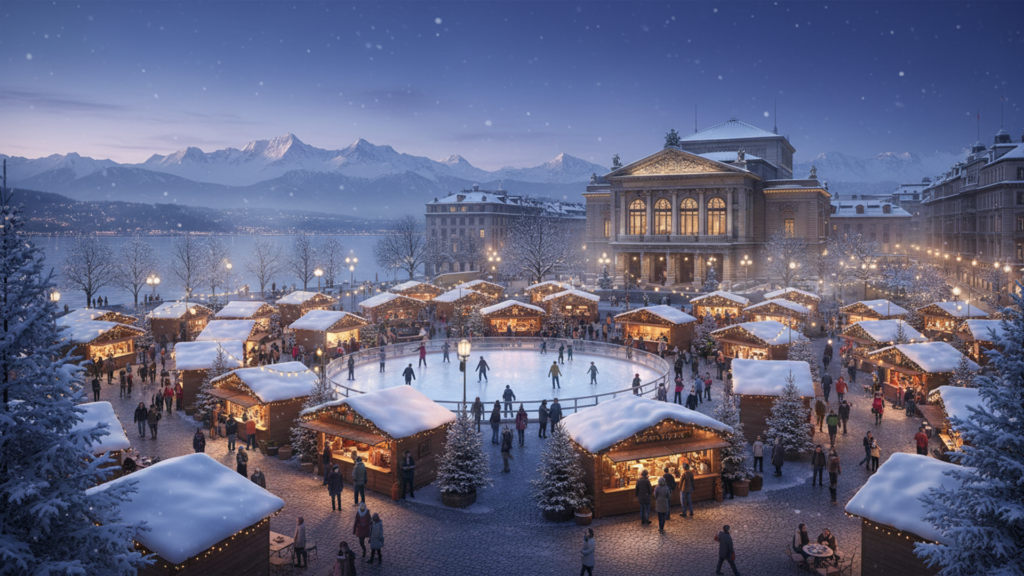
- Wienachtsdorf am Bellevue / Village at Sechseläutenplatz – a large “Christmas village” by the opera, on the square overlooking the lake, with an ice rink, wooden chalets, and a view of the Alps. This is a good place for a longer evening: you can eat fondue, drink mulled wine, and stroll along stalls with local handicrafts.
- Niederdorf Market (Old Town) – more intimate, scattered through the narrow streets of the medieval old town on the right side of the Limmat. It’s easy to find stalls with handicrafts, sweets, and Christmas decorations here, and the atmosphere is more “local” than at the main station.
Basel
- Basler Weihnacht – one of the largest and oldest markets in the country, spread across two main squares in the old town: Barfüsserplatz and Münsterplatz. Wooden chalets surround the cathedral and historic townhouses, and among the specialties are local Basler Läckerli cookies, grilled sausages, and classic glühwein.
Lucerne
- Luzerner Weihnachtsmarkt (Franziskanerplatz) – a classic, very atmospheric market by the Franciscan church, with several dozen stalls and a large Advent wreath in the middle of the square. In the background, you have a view of the historic center by the lake, and the offering includes plenty of cheeses, raclette, fondue, and Christmas sweets.
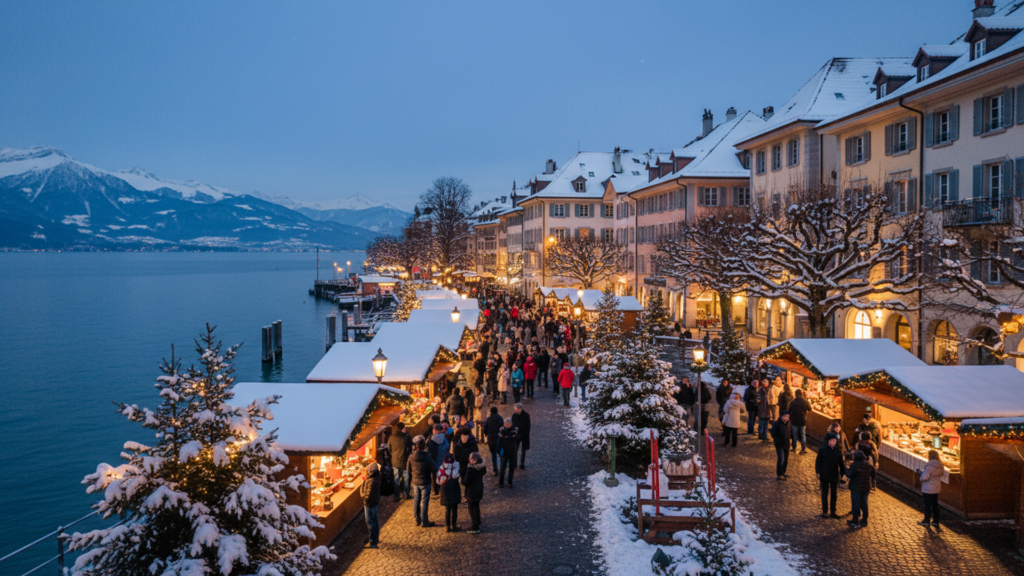
- Rapperswil-Jona – Christkindlimärt – a market spread between the waterfront and the old town, with colorful townhouse facades and a view of Lake Zurich. This is a good place for a quieter, “small-town” evening with a cup of hot drink, away from Zurich’s big-city crowds.
Coaches from Poland usually stop near city centers or at major stations, from where you can reach the Christkindlimarkt at Zurich station, the market at Franziskanerplatz in Lucerne, or Basler Weihnacht in Basel on foot in about ten minutes or by local tram. Many trip programs include a walk through the city’s main points right away, and only then free time for independent shopping and tasting – so it’s worth checking the day’s schedule in advance and adapting your own “must-see” lists accordingly.
Tips for coach travelers
Sample connections from Poland 🇵🇱
❄️ Go back to the country list ⬆️
🇸🇪 SWEDEN ✨
Sweden celebrates the holidays in the spirit of hygge, emphasizing minimalism, coziness, natural materials, subtle lighting, and a cup of warming glögg in hand. The most Christmas attractions await guests in Stockholm, Gothenburg, and Malmö. It’s worth visiting the oldest Christmas market at Skansen in Stockholm to feel the authentic atmosphere of Swedish Christmas traditions.
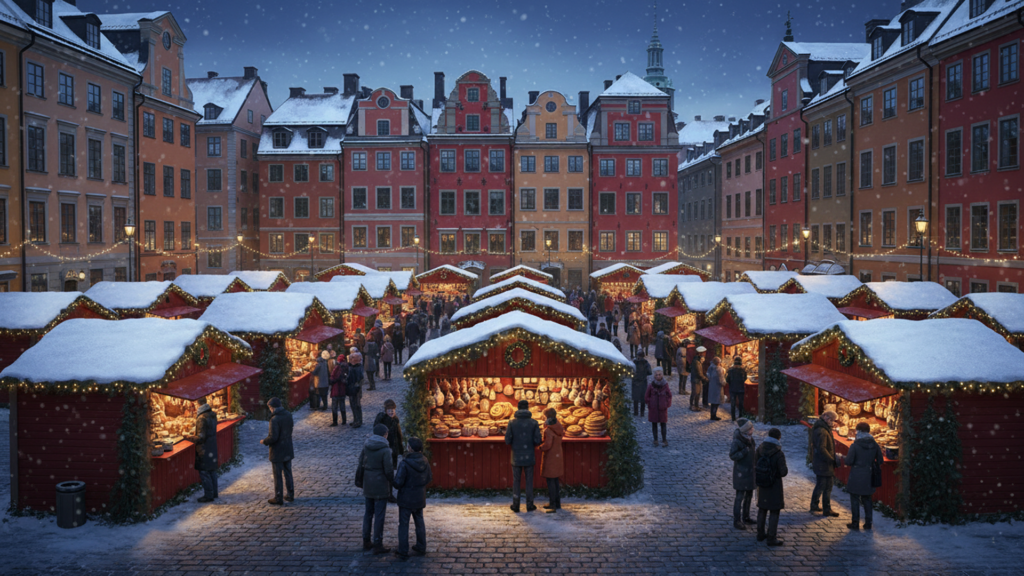
Stockholm
- Stortorget Market (Gamla Stan) – Sweden’s oldest Christmas market takes place on the main square of the old town, surrounded by colorful 17th-century townhouses. In small red chalets, you’ll find traditional Swedish handicrafts, decorations, glögg, pepparkakor (gingerbread cookies), and saffron buns called lussekatter – the perfect backdrop for a walk through winter Gamla Stan.
- Skansen Market – Skansen on Djurgården island transforms into a living textbook of Swedish traditions: between historic houses, stalls are set up with handicrafts, food, and regional products. Here you can observe old Christmas customs, listen to carols, and try classic winter dishes, including spicy pastries and warm drinks.
Gothenburg
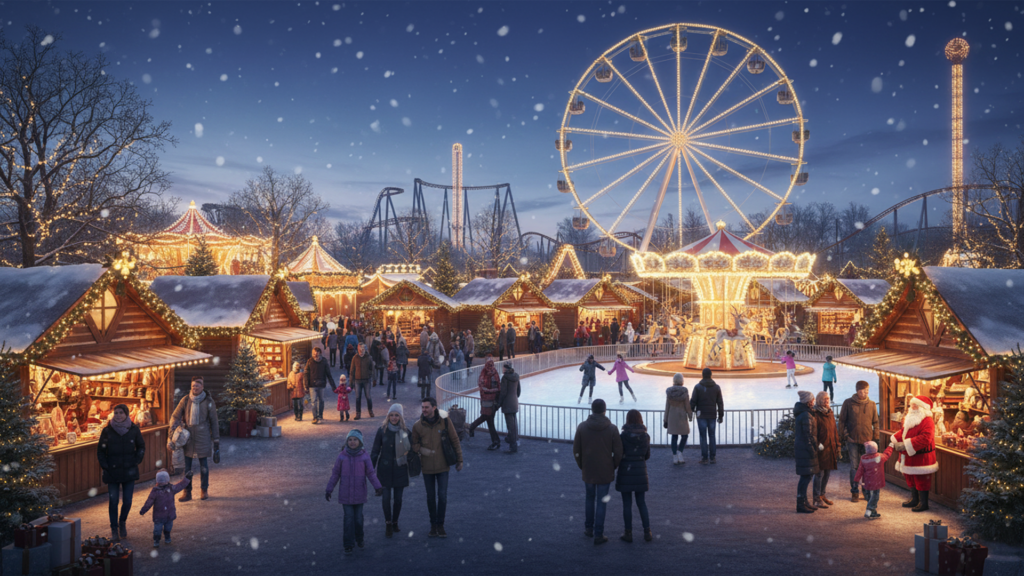
- Liseberg Market – The Liseberg amusement park transforms in winter into a fairytale town: thousands of lights, ice rinks, carousels, and avenues with stalls create one of the most family-friendly Christmas attractions in Sweden. This is a good place if you want to combine a market with an amusement park, shows, and a visit to Jultomte (Santa Claus).
Malmö
- Christmas Market – In Malmö, Christmas stalls usually appear on the main squares in the center, within a short walk from the station. The atmosphere is less touristy than in Stockholm: there’s more local handicrafts, street food, and quiet gatherings of residents over a cup of glögg.
Coach trips to Swedish Christmas markets from Poland usually combine overland travel with a ferry crossing – most often from Świnoujście to Ystad, Trelleborg, or Malmö, from where you continue on Swedish roads to Stockholm, Gothenburg, or Malmö. From ports like Ystad or Malmö to larger cities (Malmö, Gothenburg, Stockholm), there are good roads and highways, and organized coach tours usually have their routes planned to stop as close as possible to the centers with markets. Regardless of whether you’re going on a one-day trip or a longer route visiting several Swedish markets, check the opening hours of the markets in advance (some only operate on weekends or until early evening) and remember that in December in the north it gets dark quickly – which adds atmosphere but shortens “daytime” sightseeing.
Tips for coach travelers
Sample connections from Poland 🇵🇱
❄️ Go back to the country list ⬆️
🇭🇺 HUNGARY ✨
Hungary is a great destination for Christmas markets if you want to combine festive atmosphere with thermal baths, the panorama of the Danube, and very distinctive cuisine – from goulash to kürtőskalács. Most happens in Budapest, but Advent events in Debrecen and Szeged are also extensive and family-friendly.
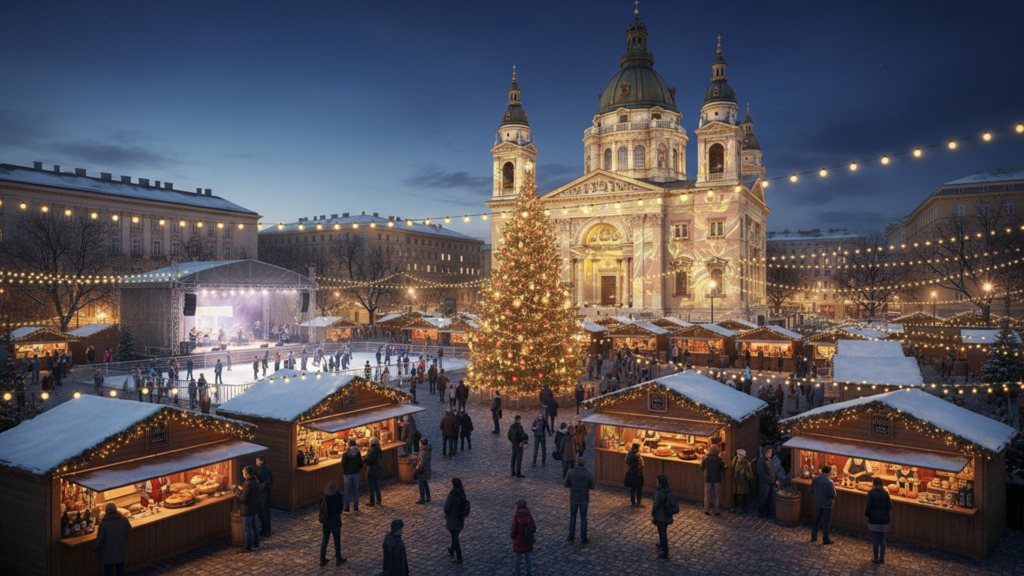
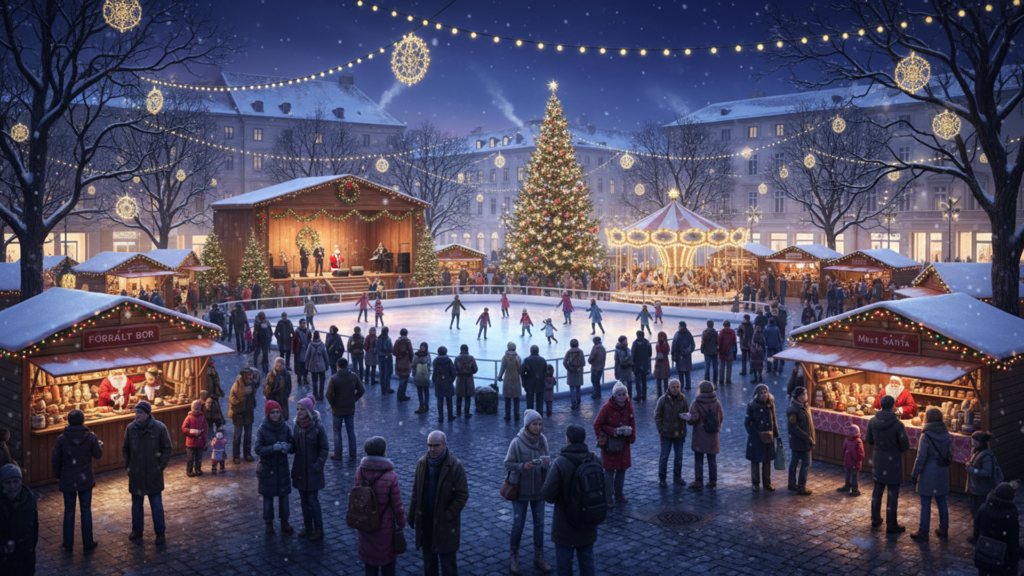
Budapest
- Advent Feast at the Basilica – One of the most famous Christmas markets in Europe takes place on the square in front of St. Stephen’s Basilica (Szent István tér) and along Zrínyi Street. In the evening, the church facade transforms into a screen for spectacular 3D light projections, a tall Christmas tree stands nearby, and the square fills with handicraft stalls, food trucks, a small ice rink, and a concert stage. Be sure to try lángos, goulash in bread, grilled sausages, roasted chestnuts, kürtőskalács, and mulled wine, and for the brave – a shot of Unicum.
- Vörösmarty Square Advent Market (Vörösmarty Classic Xmas) – This is Budapest’s second main market, in the heart of Pest, surrounded by cafes and a department store. The square has dozens of stalls with handicrafts, a stage, and gastronomy, plus a small train for children, a Christmas tree, and daily music program. The atmosphere is more “market-like” than at the Basilica – ideal for a longer stroll among stalls with ceramics, textiles, jewelry, and local sweets.
- Advent in Óbuda (Advent Óbudán) – The market in the Óbuda district takes place at Fő tér and neighboring streets on the Buda side of the city. It’s smaller, more local and family-friendly: a free ice rink, concerts, children’s shows, a large nativity scene, workshops, and handicraft stalls create a “neighborhood” festival atmosphere without the city center crowds. This is a good place for a quieter evening over a cup of mulled wine, lángos, and local pastries.
- Christmas Market at Time Out Market Budapest – this is a new gastronomic-cultural hall in the former Corvin Palace, where restaurants, bars, and event venues operate under one roof. During Christmas season, special events are organized there – including Lepopup Budapest, a large market of local brands and gifts, concerts, jazz evenings with wine, and family Sunday entertainment, all surrounded by Christmas decorations. This is more of an “urban” complement to classic markets – ideal if you want to combine Christmas shopping with good cuisine under a roof.
Debrecen
- Debrecen Advent Market – Debrecen Advent fills the pedestrian areas around Kossuth tér and Piac Street, transforming the center into a Christmas pedestrian zone. Besides about 90 stalls with regional handicrafts, sweets, and local products, there’s an ice rink, carousels, light installations, a concert stage, and zones with children’s programs and meetings with Santa. Be sure to try local confectionery products, traditional snacks from the Hajdú-Bihar region, and of course mulled wine served by the Christmas tree on the main square.
Szeged
- Szeged Christmas Weeks (Szegedi Karácsonyi Hetek) – Szeged’s “Christmas Weeks” is an extensive Advent festival spread across several city center squares – primarily Cathedral Square (Dóm tér), Dugonics tér, and Klauzál tér. Besides handicraft and food stalls, you’ll find numerous children’s workshops (“Manóműhely” – elf workshops), fire shows, concerts, performances, light projections on the cathedral facade, and weekly ceremonial Advent wreath candle lighting. Local gastronomy focuses on warming Hungarian dishes, sweets, and mulled wine – all in a slightly calmer atmosphere than Budapest, but with a full program of events throughout Advent.
Coach stations in Budapest (Népliget, Kelenföld, near railway stations) are well connected to the center – you can reach the markets at the Basilica and Vörösmarty tér by metro, tram, or bus in about ten minutes. If you plan to combine Budapest with Debrecen or Szeged, you can use Hungarian long-distance buses or trains on-site, which run several times daily between major cities. The market season in Hungary usually starts in mid-November and lasts until late December, and the Advent Feast at the Basilica often continues until New Year’s, so it’s worth matching your coach trip to the opening dates of specific markets.
Tips for coach travelers
Sample connections from Poland 🇵🇱
❄️ Go back to the country list ⬆️
🇮🇹 ITALY ✨
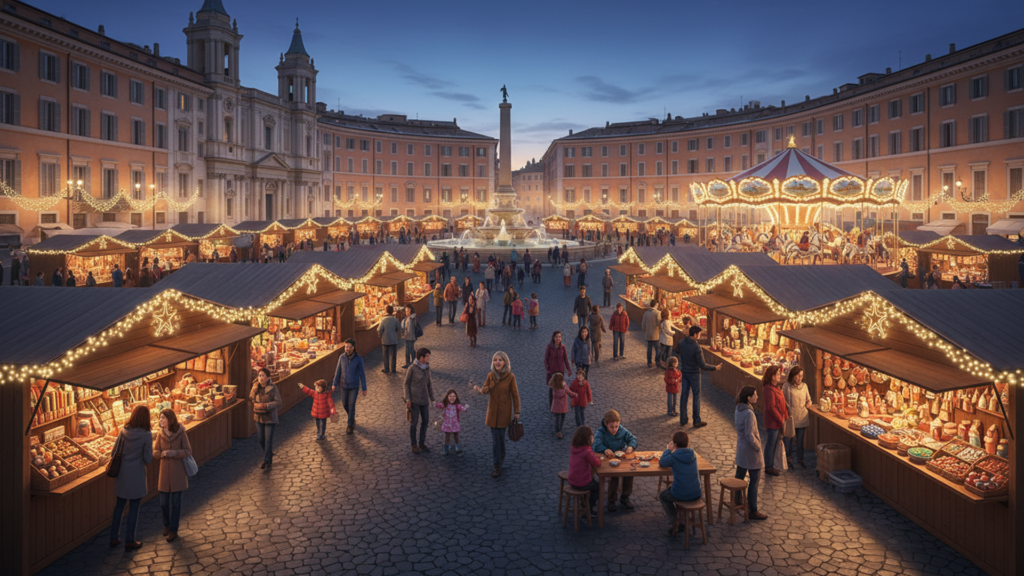
Italy combines Alpine atmospheres in the north with more “urban” celebrations in Milan, Rome, Florence, and Naples. The brightest are the South Tyrol markets (Bolzano, Merano, Bressanone), the piazza in front of the Duomo in Milan and Piazza Navona in Rome, plus local gems like Santa Croce in Florence and the “nativity street” in Naples. It’s also worth visiting the Florence market on Piazza Santa Croce to feel the unique atmosphere of the Renaissance city during Advent.
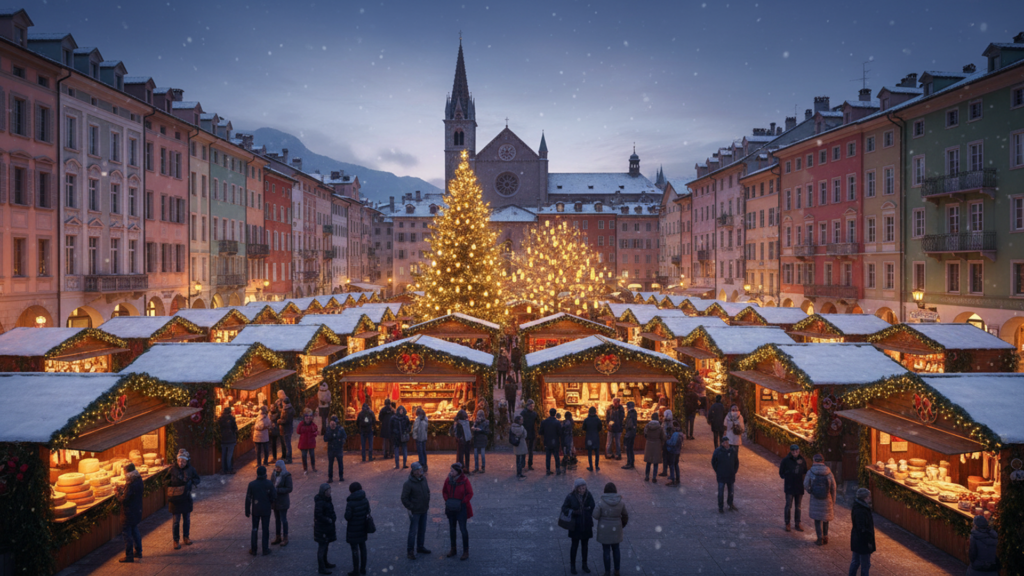
South Tyrol: Bolzano, Merano, Bressanone
- Waltherplatz Market – Mercatino di Natale in Bolzano – considered the largest in Italy; the main market occupies Piazza Walther, the city’s “living room,” surrounded by colorful townhouses and a view of the cathedral. Over 70–100 wooden chalets offer local cheeses, sausages, strudel, vin brulé, and regional handicrafts, and the evening lighting of hundreds of lights on the huge Christmas tree and “wishing tree” opens the entire Advent season.
- Mercatino di Natale di Merano (Meraner Weihnacht) – The Merano market stretches along the promenade by the Passirio River, between the spa Kurpromenade, Sandplatz, and the square by the thermal baths. About 80 stalls sell decorations, wool slippers, ceramics, and local delicacies, alongside an ice rink by the thermal baths and a rich program – concerts, children’s entertainment, and a “Christmas party” with music and cocktails.
- Mercatino di Natale di Bressanone – Brixen Christmas Market – takes place on Piazza Duomo, under the twin towers of the Santa Maria Assunta Cathedral and St. Michael’s Church, creating a very “postcard-like” setting. About 30–40 stalls offer handicrafts, decorations, and regional snacks, and the atmosphere is complemented by choirs, brass bands, and an evening light and music show on the facade of the former Hofburg bishop’s residence.
Major Cities: Milan, Rome, Florence
- Mercatino di Natale on Piazza Duomo – Milan’s main Christmas market occupies Piazza del Duomo, with over 60 wooden chalets around the Gothic cathedral and a tall Christmas tree. Italian handicrafts, decorations, torrone, sweets, and local products dominate among the stalls, and the proximity of Galleria Vittorio Emanuele II allows you to combine a Christmas stroll with boutique shopping.
- Mercatino della Befana on Piazza Navona – Operates in Rome usually from December 8 to January 6, combining the Christmas market with the Epiphany tradition and the character of the Befana witch. Stalls sell toys, sweets, nativity figurines (presepi), decorations, leather goods, and ceramics, while a carousel, children’s workshops, and street performances create a very family-friendly atmosphere until Epiphany.
- Weihnachtsmarkt Santa Croce – Florence’s most famous market is the Weihnachtsmarkt on Piazza Santa Croce, inspired by traditional German markets and filling the square with wooden chalets against the backdrop of the basilica facade. In dozens of chalets, you’ll find a mix of Italian and “Alpine” flavors (mulled wine, bratwurst, gingerbread, but also Tuscan specialties), handicrafts, and “Santa’s House” chalets with children’s entertainment.
Venice, Bologna, Naples
- Market on Campo San Polo and Natale di Vetro on Murano – In winter, Campo San Polo in Venice transforms into an ice rink surrounded by seasonal stalls, and the main Christmas village usually appears at Campo Santo Stefano – with chalets full of Murano glass, lace, and local delicacies. On Murano island, Natale di Vetro – “Christmas of Glass” takes place, with illuminated glass Christmas trees, a tunnel of light with Murano chandeliers, and demonstrations by glass masters who create decorations and jewelry live.
- Fiera di Santa Lucia – Antica Fiera di Santa Lucia is Bologna’s oldest and most traditional market, set up under the porticoes by the church of Santa Maria dei Servi on Strada Maggiore. Along the arcades stand stalls with nativity figurines, Christmas tree decorations, sweets (torrone, nougat, caramelized nuts), and local products, and the smell of roasted nuts and mulled wine officially opens the Christmas season in the city.
- Via San Gregorio Armeno (Nativity Street) – Via San Gregorio Armeno in Naples’ historic center is known as “via dei presepi” – nativity street, where workshops creating figurines and entire Christmas scenes operate year-round. During Advent, the narrow pedestrian street and surrounding alleys fill with crowds: alongside traditional presepi characters, figurines of contemporary celebrities, politicians, and footballers appear, and the whole thing combines festive bustle with a very Neapolitan sense of humor.
Coach stations in major cities usually lie near main railway stations or transport hubs, from where you can reach Christmas markets in the center on foot in about ten minutes or quickly get there by metro, tram, or bus. It’s worth checking the opening dates of markets in advance – many start at the end of November, some end just before Christmas Eve, and only selected markets (e.g., at basilicas or cathedrals) operate until New Year’s or Epiphany. Due to the high popularity of Advent weekends, it’s good to book coach tickets in advance, especially for international routes and overnight “express” trips, where the number of seats is limited.
Tips for coach travelers
Sample connections from Poland 🇵🇱
❄️ Go back to the country list ⬆️
What to Buy and How to Prepare
Markets are the perfect place to find gifts with soul: local Christmas ornaments, handmade candles, jewelry, textiles, or home decorations. Many stalls offer traditional delicacies that are begging to be taken home – such as trdelník, bratwurst, stollen, or lángos – plus the famous market mugs that often become collectible souvenirs from the trip. It’s worth bringing some cash with you, as not all stalls accept card payments, especially in smaller, more traditional parts of the markets.
Coach travel to Christmas markets can be really convenient if you prepare well – especially for overnight trips and winter weather. Below is a set of universal tips:
Before Departure
- Check carefully the departure location and time, travel duration, planned stops, and required documents (ID/passport, possible insurance confirmation, ticket in electronic or paper version).
- Book your ticket in advance, especially for Advent weekends and just before the holidays, when occupancy is highest.
What to Pack in Hand Luggage
- Layered, comfortable clothing, a warm sweatshirt or fleece, spare socks, and a scarf/hat – in winter it can be cold on the coach, and during stops and at markets you spend a lot of time outdoors.
- A small pillow (neck pillow), thin blanket or shawl, eye mask, and earplugs – these will make sleeping easier during overnight travel.
- A small toiletry bag: wet wipes, antibacterial gel, mini toothpaste and toothbrush, basic medications, and a reusable water bottle.
Food and Comfort on the Road
- Bring light snacks that don’t require refrigeration: sandwiches, nuts, granola bars, fruit, vegetable sticks.
- In winter, a thermos with tea or cream soup works great, which really warms you up before heading to the market.
- At stops, take the opportunity to stretch your legs and do some simple exercises – this will improve circulation and reduce stiffness after many hours of sitting.
On the Coach and On-Site
- Keep the most important items (documents, wallet, phone, ticket, medications, small provisions) in a fanny pack or small backpack that you can take with you to the market.
- Respect the carrier’s rules: luggage restrictions, alcohol ban on board, toilet use, cleaning up after yourself – this has a real impact on the comfort of the entire group.
- Remember that after an overnight arrival you usually go straight to sightseeing and markets – dress “ready for the city,” and leave unnecessary items in the luggage compartment or deposit if the guide offers it.
Plan Your Trip with bilety.pl
Most markets operate from the second half of November until the end of December, which gives many opportunities to adjust the date to your own calendar. Thanks to en.bilety.pl, you can check coach connections to major European cities in a few minutes, compare offers from different carriers, and choose the option that best suits your plans. You have both overnight departures and weekend options or direct routes at your disposal, and the clear layout of departure times makes it easy to plan your sightseeing time.
Booking is conveniently done online – you choose the destination, date, ticket type (one-way or return), and then all that’s left is counting down the days until departure. The coach becomes your Christmas vehicle: you board in your city and get off a few steps from the Christmas tree on the main square. A winter trip to a Christmas market is a great break from everyday life – on bilety.pl you can compare offers from different carriers and choose the perfect destination for you.